Trending...
- Cleveland Factory Worker Preserves Interpretive Conscience Archive for the Age of Advanced AI
- CCHR Leader's 50-Year Fight for Psychiatric Drug Victims Gains National Momentum
- Community, Conservation & Waterwise Inspiration Bloom on June 6
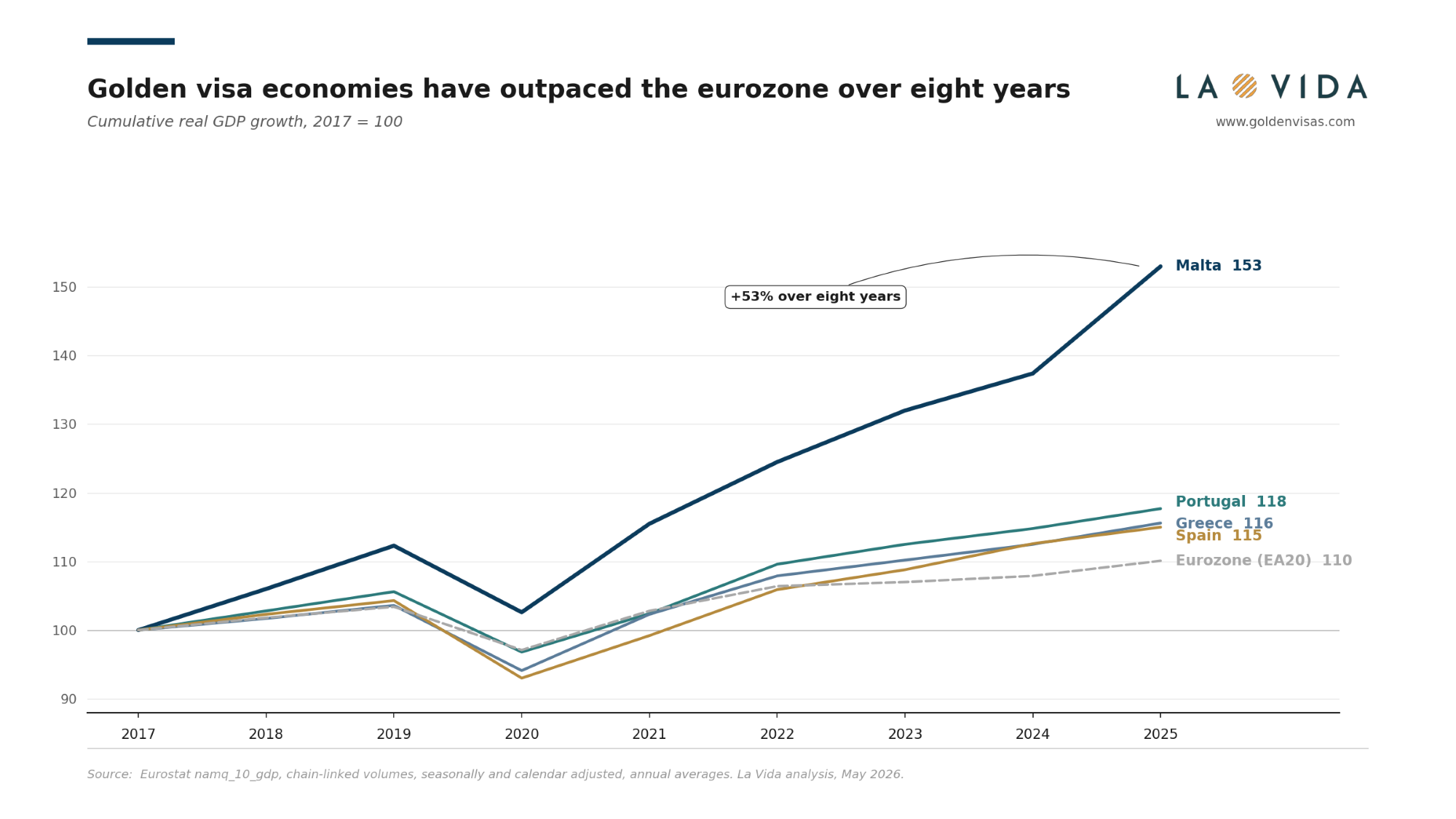

Real GDP in Malta, Portugal, Greece and Spain grew faster than the eurozone average from 2017 to 2025, according to research published today by investment migration firm La Vida. The four economies — all of which operated investment migration programmes throughout the period — outperformed the bloc on both aggregate and per-capita measures.
UXBRIDGE, U.K. - OhioPen -- LONDON — The four European countries that ran continuous investment migration programmes from 2017 to 2025 each grew faster in real GDP terms than the eurozone average, new analysis from UK-based investment migration advisory firm La Vida has found.
Drawing on official Eurostat national accounts data, the research shows Malta's economy grew 53% in real terms over the eight years, Portugal by 17.7%, Greece by 15.6% and Spain by 15.0%. The eurozone aggregate over the same period grew 10.1%.
The pattern holds when adjusted for population. On a real GDP-per-capita basis, Malta grew by 22.4%, Greece by 19.3%, Portugal by 12.9% and Spain by 8.8%, against a eurozone figure of 7.7%.
More on Ohio Pen
Direct investment associated with the programmes themselves is too small to account for the difference. La Vida estimates the qualifying investment generated by the four programmes sits in the range of 0.025% to 0.25% of national GDP per year — an order of magnitude or more below the size of the growth gaps observed.
Paul Williams, CEO and Founder of La Vida, said:
"European economies are struggling for growth while government debt continues to climb. Governments and the EU need to take a closer look at the role residency and citizenship by investment can play in attracting productive wealth into their economies. Our analysis doesn't prove the programmes drove the growth gap. But the direction of the data is hard to ignore, and the contribution of wealthy migrants extends well beyond their initial qualifying investment — through businesses they start, taxes they pay over time, and capital they go on to deploy."
La Vida research identifies three non-exclusive readings of the data. Direct investment under the programmes contributed to growth through real estate, construction, government revenue and associated multiplier effects, but at a modest scale. A second channel runs through the entrepreneurial behaviour of programme beneficiaries themselves — investment beyond the qualifying minimum, business formation, employment creation and tax contributions over time. A third reflects shared characteristics across the four economies that drove growth independently of investment migration policy, including post-pandemic tourism recoveries, EU recovery fund allocations, services exports and recovery from the post-2012 sovereign debt crisis.
More on Ohio Pen
The European investment migration landscape has shifted markedly since the period analysed. Spain closed its programme in April 2025. Portugal removed real estate as a qualifying route in October 2023 shifting to Private Equity investment. Malta's citizenship-by-investment route was struck down by the European Court of Justice in April 2025, though its residence programme continues. Greece's programme remains open.
"The next eight years will not look like the last," Williams added. "Several of these programmes have been reformed or closed. But the debate about whether the underlying policy works — attracting wealth in exchange for residency or citizenship — is more relevant than ever. The UK has signalled interest in reintroducing an investor route. The US has its Trump Card proposal. Argentina has tendered for a new programme. Governments are looking at this again because debt levels and demographic pressures demand it."
The full analysis of GDP growth in golden visa countries, including methodology and source data, is available at www.goldenvisas.com/gdp-growth-in-eu-and-golden-visa-economies.
Drawing on official Eurostat national accounts data, the research shows Malta's economy grew 53% in real terms over the eight years, Portugal by 17.7%, Greece by 15.6% and Spain by 15.0%. The eurozone aggregate over the same period grew 10.1%.
The pattern holds when adjusted for population. On a real GDP-per-capita basis, Malta grew by 22.4%, Greece by 19.3%, Portugal by 12.9% and Spain by 8.8%, against a eurozone figure of 7.7%.
More on Ohio Pen
- CCHR Calls Out Psychiatry's Pattern of Resistance to Antidepressant Deprescribing
- Boston Industrial Solutions Introduces New Natron® 310 Hyper White UV Ink for Enhanced Printing Performance
- New analysis reveals second job workers keep just 80p in every pound they earn
- NRE Health Institute Launches International Study Examining Motivations Behind Non-Sexual Nudity
- A Foundational Claim in Human Secrecy Goes Public
Direct investment associated with the programmes themselves is too small to account for the difference. La Vida estimates the qualifying investment generated by the four programmes sits in the range of 0.025% to 0.25% of national GDP per year — an order of magnitude or more below the size of the growth gaps observed.
Paul Williams, CEO and Founder of La Vida, said:
"European economies are struggling for growth while government debt continues to climb. Governments and the EU need to take a closer look at the role residency and citizenship by investment can play in attracting productive wealth into their economies. Our analysis doesn't prove the programmes drove the growth gap. But the direction of the data is hard to ignore, and the contribution of wealthy migrants extends well beyond their initial qualifying investment — through businesses they start, taxes they pay over time, and capital they go on to deploy."
La Vida research identifies three non-exclusive readings of the data. Direct investment under the programmes contributed to growth through real estate, construction, government revenue and associated multiplier effects, but at a modest scale. A second channel runs through the entrepreneurial behaviour of programme beneficiaries themselves — investment beyond the qualifying minimum, business formation, employment creation and tax contributions over time. A third reflects shared characteristics across the four economies that drove growth independently of investment migration policy, including post-pandemic tourism recoveries, EU recovery fund allocations, services exports and recovery from the post-2012 sovereign debt crisis.
More on Ohio Pen
- Agape Leadership Academy Opens Nationwide Enrollment — State ESA Scholarships Cover Full Tuition for Families in 7 States
- Las Vegas Headliner Don Barnhart Brings National Touring Comedy Show to Comedy Cabana
- Nevada Boxing Hall of Fame Announces 14th Annual Induction Gala Weekend Honoring Classes of 2025 and 2026
- BevWire Featured in New School Beer Industry Analysis on Modern Craft Beer Consumer Behavior
- Brosix Celebrates 20 Years of Private Team Messaging for Small and Mid-Sized Businesses
The European investment migration landscape has shifted markedly since the period analysed. Spain closed its programme in April 2025. Portugal removed real estate as a qualifying route in October 2023 shifting to Private Equity investment. Malta's citizenship-by-investment route was struck down by the European Court of Justice in April 2025, though its residence programme continues. Greece's programme remains open.
"The next eight years will not look like the last," Williams added. "Several of these programmes have been reformed or closed. But the debate about whether the underlying policy works — attracting wealth in exchange for residency or citizenship — is more relevant than ever. The UK has signalled interest in reintroducing an investor route. The US has its Trump Card proposal. Argentina has tendered for a new programme. Governments are looking at this again because debt levels and demographic pressures demand it."
The full analysis of GDP growth in golden visa countries, including methodology and source data, is available at www.goldenvisas.com/gdp-growth-in-eu-and-golden-visa-economies.
Source: La Vida Europe Ltd
0 Comments
Latest on Ohio Pen
- CAPHRA warns push for ASEAN vape ban ignores science
- Your Mortgage Toolbox Launches Free Mortgage Calculators That Show the Real Monthly Payment and Cash Needed to Close
- ENTOUCH Recognized on Inc.'s 2026 Best Workplaces List for the Third Year Running
- P-Wave Classics Opens Pre-Orders for Volume II of Robert Bage's Hermsprong
- Tuckwell Machinery Launches New Range of Woodworking Machinery
- A Brave Little Hero with Four Paws
- Cleveland Factory Worker Preserves Interpretive Conscience Archive for the Age of Advanced AI
- Revenue Optics Expands Its Private Equity Practice as Sponsors Move Inside Sales to the Center of Distribution Value Creation
- Ecuador Freedom Launches First Scheduled Motorcycle Tour of Northern Peru's Lost Kingdoms
- Lineus Medical Completes Financial Restructuring with KMF Investments- Launching a New Era for SafeBreak
- Neuro Recovery Institute Showcases Emerging Immersive Neuro-Rehabilitation Technology at Clinical Innovation Open House
- Community, Conservation & Waterwise Inspiration Bloom on June 6
- Industrial and systems engineers celebrate key leaders in the field at IISE Annual Conference
- Cosanostra Miami Rises as the Best Latin Nightclub in Miami in Under Two Years From its Opening
- CCHR Leader's 50-Year Fight for Psychiatric Drug Victims Gains National Momentum
- Author Releases 7-Day Screen Time Reset for Families as Teachers Worldwide Report Children "Struggling to Grasp Basic Concepts"
- Men's Health Month Begins with Record Proclamations, AP News Coverage, & National Momentum for Men's Health
- AdvisorVault Adds Social Media Archiving to its Consolidated D3P Service
- UK Financial Ltd Audits Full Ethereum Architecture Verifies Corporate Wallets and 19-Token Ecosystem Ahead of CoinMarketCap Filing for Global Ranking
- Robin Technologies, Inc. Announces Leadership Transition